Table of Contents
Vuronu

 “Harmony”
| The island of Vuronu has always been a mysterious elusive place, exceptional in it’s fertility. It was once home to both humans and it’s own unique sentient race known as the chromatic. That was centuries ago, before choreography could place its location accurately on a map. It was a place of much excitement and early commerce; those coming to the island would bring species of plant or animal from home, and return with fantastic wildlife like never seen on the main lands. The relationship between the humans and chromatic was peaceful at that time, but things have changed and it seems only the chromatic remain. The once peaceful waters around Vuronu are now in constant torment, and a stormy sea makes it impossible to find the island until you are literally upon it. |
Landscape
| Thanks to the careful care of the native sentient species, The Chromatic the flora and fauna of the island flourish and grow with vigor unseen on any other part of the world. It has been a place of balance, harboring species from all regions and climates. However, as the history of Vuronu has varied, so has it’s landscape. At the time this story takes place, Vuronu’s delicate balance has broken, and it’s lands are evidence this. Regardless of specific reign – mountains, field, lake, what have you – Vuronu is divided into two distinct types of landscape. |  Map |
The Green Lands
| The Green Lands are most reminiscent of how the island of Vuronu once was. These areas are fertile and teeming with life of all kinds. However, unlike the well-balanced nature of the past, they are now wildly overgrown. Plants grow to double, triple, or even four times their original size. This overgrowth clutters the skyline with gigantic leaves and boughs, constantly at battle for sunlight. In the same way, the wildlife is always fighting for ever dwindling swaths of territory. The Green Lands are where the nomadic Vu-Koko over-zealously tend the flora. |  Lush Growth in the Green Lands |
Common Features
Biomes
Flora & Fauna
- Leatheryfruit Tree:
Attributes
Na: Nakiro
Frequency: Common in The Green Lands
No. Appearing: 1-5
Armor Class: 7
Secondary Armor Class: 8 (produce)
Hit Points: 4 HD
Move: None
Special Defenses: None
Magic Resistance: None
Size: Large (avg. 10 ft., max 15 ft.)
Growth cycle: 1 yr (woody perennial)
Production: 15(+5 per yr of age up to 9)/cycle
Lifespan: up to 85 yrs
Lethality: Harmless
Toxicity: Very mild (see below)
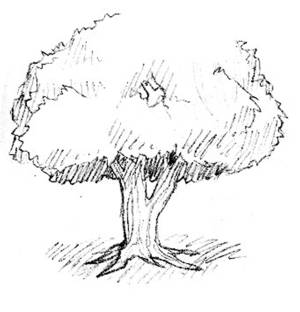
Adult Leatheryfruit TreeDescription

LeafThe Leatheryfruit Tree most resembles an apple tree. It has a normal growth cycle, which is as follows. Starting from spring and ending on fall, the tree grows and blooms, bears fruit, and becomes dormant for most of the remaining two seasons, respectively. The tree is most known for it’s beautiful blossoms, which are light blue and golden yellow in color, and about 5 inches in diameter. The fruit produced by the tree is 6 inches in diameter at its widest point, and about 4.5 inches in height. 
Blossom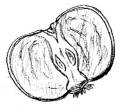
Fruit Cross-SectionThe Leatheryfruit Tree’s fruit has a very tough leathery exterior, which explains the common name for the tree. The skin of the fruit is a pale brown color, and is most easily penetrated by cutting, not tearing or chewing. The meat of the fruit is very stringy and sticky, with a red color to it. In the center of the fruit is a tough section where the seeds are kept. Despite a very sweet odor, the fruit is quite bitter in taste. If one eats too much of the fruit, it can cause a mild headache, but no serious harm.
If cooked and then dried, the fruit can be kept for a long time. Other than the fruit, very little of the Leatheryfruit tree is put to use by the chromatic.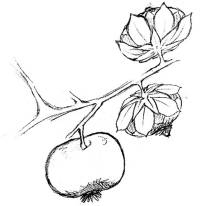
Fruit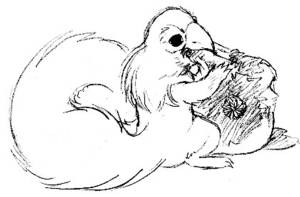
Skin of the fruit is easily penetrated by the sharp beak of a Parrotbeak Squirrel - Tri-Flower:
Attributes
Na: Nakirokosa
Frequency: Rare in The Green Lands
No. Appearing: 1-20
Armor Class: 8
Secondary Armor Class: 6 (produce)
Hit Points: 2 HD
Move: None
Special Defenses: see below
Magic Resistance: 20%
Size: Large (avg. 7 ft., max 14 ft.)
Growth cycle: 3 yrs (herbaceous perennial)
Production: 1/cycle
Lifespan: up to 21 yrs
Lethality: Harmless
Toxicity: Mild (see below)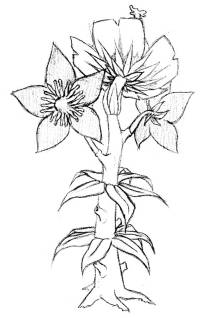
Tri-FlowerDescription
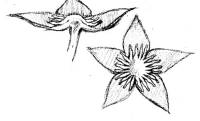
Male FlowerThe Tri-Flower plant resembles giant green flower stalk, with only 3 blooms at one time. The flower in the middle is the female part, which is white in color, and the two flowers to the side are the male parts, which are a deep red. For each 3-year cycle, the plant grows a section roughly 2’ in height, which is separated from previous sections by leaves. The flowers -which are about 3 to 4ft in diameter -bloom during the spring of the third year for about a month. If pollination occurs within this month (usually by a small bird), the fruit is fully ripened by mid-fall of that year. The rest of the growth cycle is spent growing in height and size.
All through spring and summer of the third year, the plant has a slippery sheen on its stalk, making it hard to climb for most bugs and small animals. However, the flowers are still vulnerable to flying creatures that decide to have a snack.
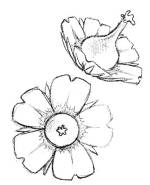
Female Flower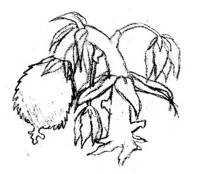
Tri-Flower plant in fall of its 6th yearThe fruit of the Tri-Flower plant usually grows to about 1ft. 6 in. in diameter and 2 ft. in height. The outer shell is covered in many fine but stiff green spikes, giving it a fuzzy appearance. If held against the direction of the spikes, it can be very painful. The interior of the fruit contains about 8 large hollow sections separated by thick walls of inedible plant matter in which the seeds are nestled. Within the hollows there is light golden brown gelatinous meat, in round lumpy forms, usually looking like 3 malformed spheres stuck together. The outside of the meat is covered in a thin layer of dry powder that has no taste, which makes it easy to handle. Within the dry powder, the meat has the consistency of stiff jell-o. There is no odor, but the taste is sweet. If eaten too liberally, the meat of this fruit will cause intestinal discomfort and diarrhea, but no serious harm.
The hard, spiny shells of the fruit are often used by Chromatic to make armor and helmets. Once dead, strips off the stalk of the plant make very strong and flexible ropes.
Because most of the Tri-Flower plants are on the same cycle, production occurs almost all in the same year. Chromatic enjoy celebrating the occasion!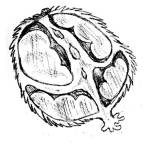
Fruit cross-section


* ++ Parrotbeak Squirrel |{{page>Monster:Parrotbeak Squirrel&noheader}} ++ [[Monster:Parrotbeak Squirrel|(...)]]
* ++ Giant Rat |{{page>Monster:Giant Rat&noheader}} ++ [[Monster:Giant Rat|(...)]]
Landmarks
The Black Lands
| The Black Lands are located in various areas around Vuronu. Slowly seeping though the lands like a disease, the back lands are sparse and hardly alive at all. Nothing can survive save for a few slow-growing species of plant, most of them carnivorous to make up for the lack of nutrients in the soil around them. For example, black lands near sea level are deadly swamp-like areas, guarded by ancient groves of Poison Swamp Willows. These trees survive by filling the water around them with corrosive acids, then absorbing what remains of anything trying to approach them. Although the back lands are devoid of much life, they are home to Rogue Elementals and Vengeful Spirits, making them even more dangerous. |
 The Black Lands |
Common Features
Biomes
Woodland
Carnivorous Swamps
Most of the Black Lands are near sea level, which is where this biome is predominate. These swamps are flooded areas, often extremely humid. They mark the last breath of life of the sort found in the Grey Lands, and introduce new methods for surviving off what little nutrients are offered.
Desert
The deepest and oldest areas of the Black Lands are completely barren and arid; having no resources to offer, they support no life. The growth of these areas has been unnaturally fast, as the Low Chromatic draw heavily on the island's resources for their purposes. With little or no magic or life to speak of, these areas can and do hold a great deal of spiritual forces.
Flora & Fauna
- Poison Swamp Willow:
Attributes
Na: Nakoro
Frequency: Common in The Black Lands
No. Appearing: 2-10
Armor Class: 6
Secondary Armor Class: 7 (produce)
Hit Points: 2 HD
Move: None
Special Defenses: Poison (see below)
Magic Resistance: 5%
Size: Large (avg. 19 ft., max 28 ft.)
Growth cycle: 1 yr (woody perennial)
Production: 20(+4 per yr of age up to 10)/cycle
Lifespan: unknown
Lethality: Very dangerous
Toxicity: Lethal / None (see below)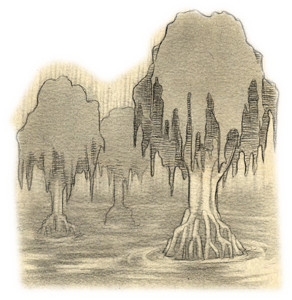
Adult Poison Swamp WillowsDescription
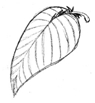
LeafDespite the name, the Poison Swamp Willow is not technically a willow tree- it only resembles one in arrangement of leaves. It has a normal growth cycle. The bark of the tree is an ashen gray color, with a lighter gray papery outer layer. The leaves are a very deep, saturated green, with a few sharp spikes that protrude from the joining point of stem and leaf. The tree is also often host to Black Moss, which is immune to the poison sap of the tree, and is therefore able to hang feely in its branches. The roots of the tree extend up above ground, often accounting for about a fourth of the tree’s height.

Flower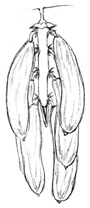
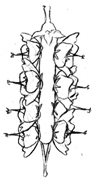
Growth with seed podsThe produce of this tree hangs on small growths about 6 inches long, which hide in the interior of the tree, hanging form branches. These growths are long and skinny, ending in a very hard spike, which is always wet with the poison sap of the tree. On each of the growths, there is potential for 8 pods to grow. In spring, 8 small white flowers bloom, 4 in a column on each side of the growth. If pollinated, the pods grow to be about 6 inches in length each. The pods are a dark green color, nearly black. When the time comes, only the pods fall from the tree, not the entire growth. A growth will fall from the tree after 4 years of production. Each pod usually contains four iridescent seeds, each with a slimy outer layer of the tree’s poison concoction. If consumed this way, even a miniscule fraction of one seed is enough to cause death. However, if the seeds are left in running water for at least 48 hours, they become completely harmless and edible. The taste of a leeched seed is very similar to that of a cashew, fatty and slightly sweet
Growth with flowers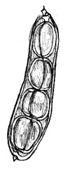
Seed pod cross-sectionIf the tree is disturbed in any way, poison sap form various growths will drip down, causing corrosive burning on contact with flesh. Without being disturbed, the poison sap usually drips from one pod about once every 2 hours. On a full-grown tree, this can be quite often. Because of this, the water around the tree can often be unsafe to walk in. In areas with a large concentration of these trees the concentration of poison sap in the water is high and walking in it for only a few minutes can begin to cause serious harm. However, chromatic weave together Black Moss into crude boots, allowing one to walk through the water unharmed for about an hour, until the moss becomes saturated. Even though the sap has a very subtle odor, in groves the air has a sour smell, leaving the eyes, mouth, and nose burning and itchy. 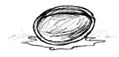
Seed


Landmarks
In the heart of the Black Lands lies Suvayu, an ancient city built with the Obsidian Gate and it's center.
Settlements
| Although most of Vuronu is unspoiled by construction and building, there are a number of cities and settlements. City-dwelling chromatic live near the center of the island, protected by a city once built with human hands. Toward the shore, there are a number of abandoned towns, some of them ravaged and decaying in the black lands, others torn apart by overgrowth in the green lands. The is no evidence left where the docks and ships once were, the storm surrounding the island having long since swallowed it all. |