Table of Contents
The Herbiary
Plants of the Green Lands
- Leatheryfruit Tree:
Attributes
Na: Nakiro
Frequency: Common in The Green Lands
No. Appearing: 1-5
Armor Class: 7
Secondary Armor Class: 8 (produce)
Hit Points: 4 HD
Move: None
Special Defenses: None
Magic Resistance: None
Size: Large (avg. 10 ft., max 15 ft.)
Growth cycle: 1 yr (woody perennial)
Production: 15(+5 per yr of age up to 9)/cycle
Lifespan: up to 85 yrs
Lethality: Harmless
Toxicity: Very mild (see below)
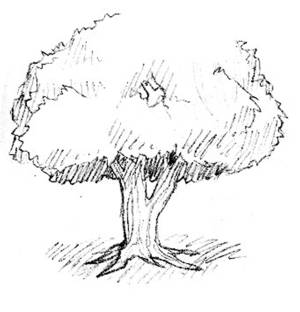
Adult Leatheryfruit TreeDescription

LeafThe Leatheryfruit Tree most resembles an apple tree. It has a normal growth cycle, which is as follows. Starting from spring and ending on fall, the tree grows and blooms, bears fruit, and becomes dormant for most of the remaining two seasons, respectively. The tree is most known for it’s beautiful blossoms, which are light blue and golden yellow in color, and about 5 inches in diameter. The fruit produced by the tree is 6 inches in diameter at its widest point, and about 4.5 inches in height. 
Blossom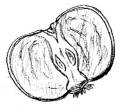
Fruit Cross-SectionThe Leatheryfruit Tree’s fruit has a very tough leathery exterior, which explains the common name for the tree. The skin of the fruit is a pale brown color, and is most easily penetrated by cutting, not tearing or chewing. The meat of the fruit is very stringy and sticky, with a red color to it. In the center of the fruit is a tough section where the seeds are kept. Despite a very sweet odor, the fruit is quite bitter in taste. If one eats too much of the fruit, it can cause a mild headache, but no serious harm.
If cooked and then dried, the fruit can be kept for a long time. Other than the fruit, very little of the Leatheryfruit tree is put to use by the chromatic.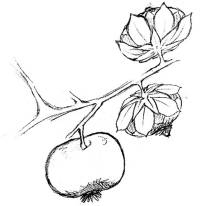
Fruit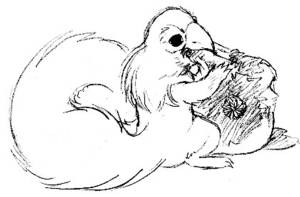
Skin of the fruit is easily penetrated by the sharp beak of a Parrotbeak Squirrel - Tri-Flower:
Attributes
Na: Nakirokosa
Frequency: Rare in The Green Lands
No. Appearing: 1-20
Armor Class: 8
Secondary Armor Class: 6 (produce)
Hit Points: 2 HD
Move: None
Special Defenses: see below
Magic Resistance: 20%
Size: Large (avg. 7 ft., max 14 ft.)
Growth cycle: 3 yrs (herbaceous perennial)
Production: 1/cycle
Lifespan: up to 21 yrs
Lethality: Harmless
Toxicity: Mild (see below)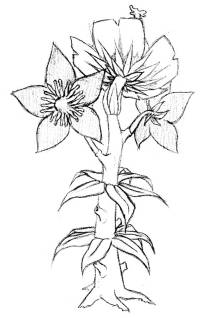
Tri-FlowerDescription
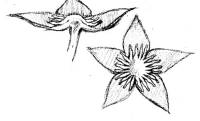
Male FlowerThe Tri-Flower plant resembles giant green flower stalk, with only 3 blooms at one time. The flower in the middle is the female part, which is white in color, and the two flowers to the side are the male parts, which are a deep red. For each 3-year cycle, the plant grows a section roughly 2’ in height, which is separated from previous sections by leaves. The flowers -which are about 3 to 4ft in diameter -bloom during the spring of the third year for about a month. If pollination occurs within this month (usually by a small bird), the fruit is fully ripened by mid-fall of that year. The rest of the growth cycle is spent growing in height and size.
All through spring and summer of the third year, the plant has a slippery sheen on its stalk, making it hard to climb for most bugs and small animals. However, the flowers are still vulnerable to flying creatures that decide to have a snack.
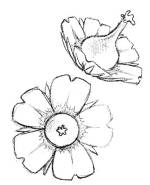
Female Flower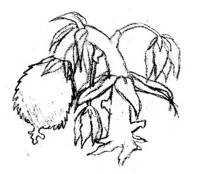
Tri-Flower plant in fall of its 6th yearThe fruit of the Tri-Flower plant usually grows to about 1ft. 6 in. in diameter and 2 ft. in height. The outer shell is covered in many fine but stiff green spikes, giving it a fuzzy appearance. If held against the direction of the spikes, it can be very painful. The interior of the fruit contains about 8 large hollow sections separated by thick walls of inedible plant matter in which the seeds are nestled. Within the hollows there is light golden brown gelatinous meat, in round lumpy forms, usually looking like 3 malformed spheres stuck together. The outside of the meat is covered in a thin layer of dry powder that has no taste, which makes it easy to handle. Within the dry powder, the meat has the consistency of stiff jell-o. There is no odor, but the taste is sweet. If eaten too liberally, the meat of this fruit will cause intestinal discomfort and diarrhea, but no serious harm.
The hard, spiny shells of the fruit are often used by Chromatic to make armor and helmets. Once dead, strips off the stalk of the plant make very strong and flexible ropes.
Because most of the Tri-Flower plants are on the same cycle, production occurs almost all in the same year. Chromatic enjoy celebrating the occasion!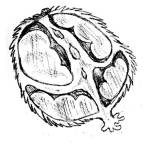
Fruit cross-section


Plants of the Grey Lands
- Nirovo's Slime:
- Shrieker:
Medium Plant
- Armor Class: 5
- Hit Points: 13 (3d8)
- Speed: walk 0 ft.
- Challenge Rating: 0 (25 XP)
- Source: A5e Monstrous Menagerie, page 212
STR DEX CON INT WIS CHA -5 -5 +0 -5 -4 -5 - Damage Vulnerabilities: fire
- Condition Immunities: blinded, charmed, deafened, fatigue, frightened, prone, restrained, stunned
- Senses: blindsight 30 ft. (blind beyond this radius), passive Perception 6
==== Special Abilities ====
- False Appearance: While motionless, the shrieker is indistinguishable from a normal fungus.
==== Reactions ====
- Shriek: If the shrieker perceives a creature within 30 feet or if an area of bright light is within 30 feet it shrieks loudly and continuously. The shriek is audible within 300 feet. The shrieker continues to shriek for 1 minute after the creature or light has moved away.
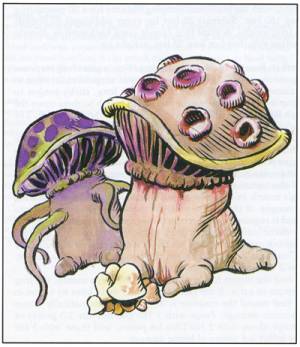
Shrieker
Source: A5e Monstrous Menagerie

Plants of the Black Lands
- Poison Swamp Willow:
Attributes
Na: Nakoro
Frequency: Common in The Black Lands
No. Appearing: 2-10
Armor Class: 6
Secondary Armor Class: 7 (produce)
Hit Points: 2 HD
Move: None
Special Defenses: Poison (see below)
Magic Resistance: 5%
Size: Large (avg. 19 ft., max 28 ft.)
Growth cycle: 1 yr (woody perennial)
Production: 20(+4 per yr of age up to 10)/cycle
Lifespan: unknown
Lethality: Very dangerous
Toxicity: Lethal / None (see below)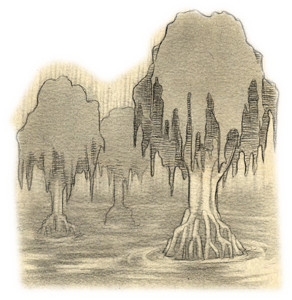
Adult Poison Swamp WillowsDescription
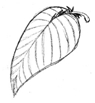
LeafDespite the name, the Poison Swamp Willow is not technically a willow tree- it only resembles one in arrangement of leaves. It has a normal growth cycle. The bark of the tree is an ashen gray color, with a lighter gray papery outer layer. The leaves are a very deep, saturated green, with a few sharp spikes that protrude from the joining point of stem and leaf. The tree is also often host to Black Moss, which is immune to the poison sap of the tree, and is therefore able to hang feely in its branches. The roots of the tree extend up above ground, often accounting for about a fourth of the tree’s height.

Flower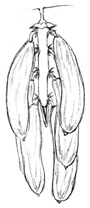
Growth with seed podsThe produce of this tree hangs on small growths about 6 inches long, which hide in the interior of the tree, hanging form branches. These growths are long and skinny, ending in a very hard spike, which is always wet with the poison sap of the tree. On each of the growths, there is potential for 8 pods to grow. In spring, 8 small white flowers bloom, 4 in a column on each side of the growth. If pollinated, the pods grow to be about 6 inches in length each. The pods are a dark green color, nearly black. When the time comes, only the pods fall from the tree, not the entire growth. A growth will fall from the tree after 4 years of production. Each pod usually contains four iridescent seeds, each with a slimy outer layer of the tree’s poison concoction. If consumed this way, even a miniscule fraction of one seed is enough to cause death. However, if the seeds are left in running water for at least 48 hours, they become completely harmless and edible. The taste of a leeched seed is very similar to that of a cashew, fatty and slightly sweet
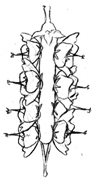
Growth with flowers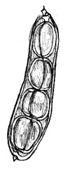
Seed pod cross-sectionIf the tree is disturbed in any way, poison sap form various growths will drip down, causing corrosive burning on contact with flesh. Without being disturbed, the poison sap usually drips from one pod about once every 2 hours. On a full-grown tree, this can be quite often. Because of this, the water around the tree can often be unsafe to walk in. In areas with a large concentration of these trees the concentration of poison sap in the water is high and walking in it for only a few minutes can begin to cause serious harm. However, chromatic weave together Black Moss into crude boots, allowing one to walk through the water unharmed for about an hour, until the moss becomes saturated. Even though the sap has a very subtle odor, in groves the air has a sour smell, leaving the eyes, mouth, and nose burning and itchy. 
Seed


Original Docs
Except where otherwise noted, content on this wiki is licensed under the following license: CC Attribution-Share Alike 4.0 International


